


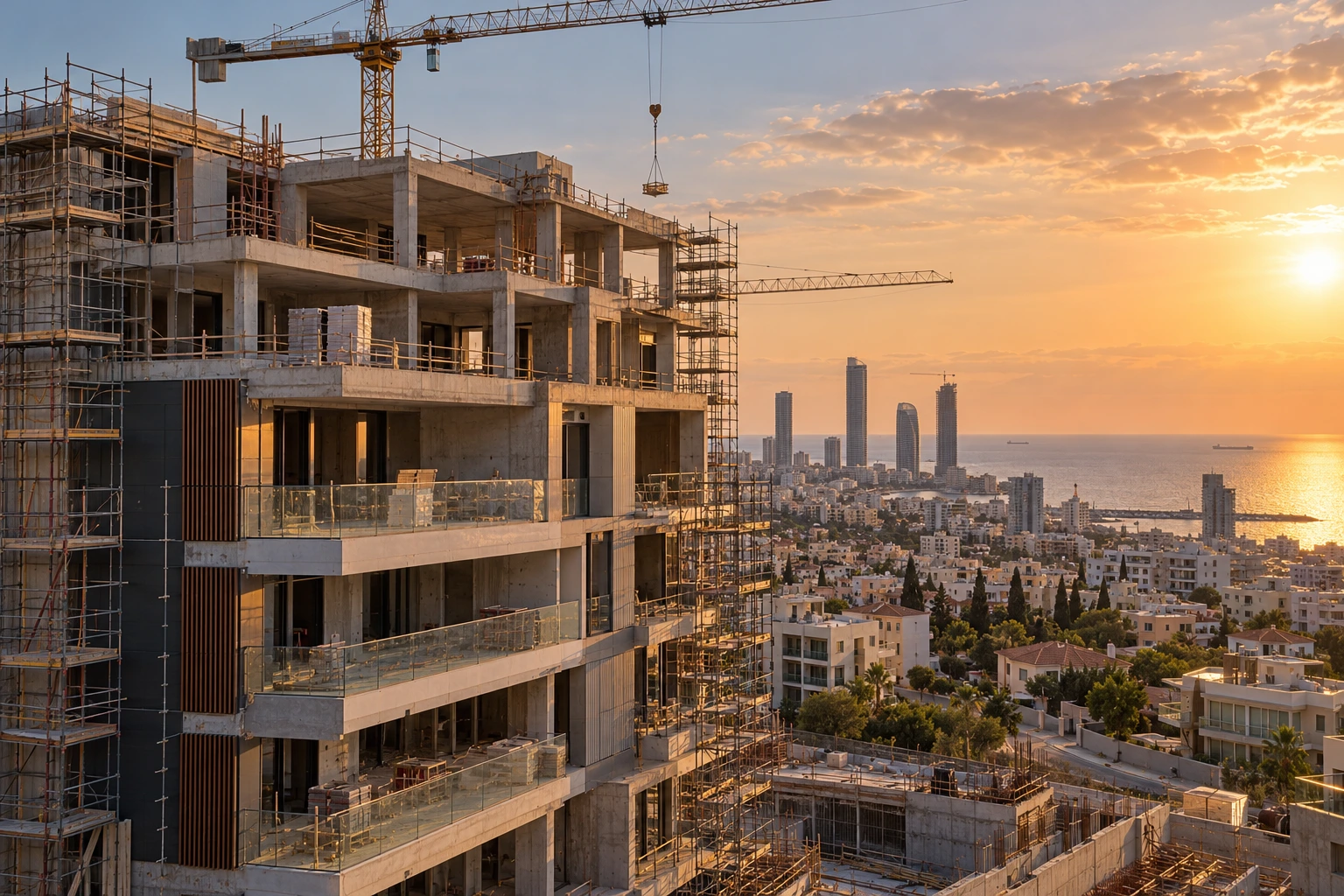
Property Developers in Limassol: 9 Questions That Expose the Wrong One Before You Pay a Deposit
The best property developers in Limassol are the ones that can show you finished buildings with title deeds already issued, a planning and building permit for your project, a clean Land Registry search on the plot, a contract your own lawyer can deposit at the Land Registry, and a clear payment schedule tied to construction stages. If a developer hesitates on any of these, walk away, no matter how good the brochure looks.
Here is something most people won’t tell you: in Limassol, you are not really buying an apartment. You are buying a developer.
The apartment doesn’t exist yet, or it exists only as concrete and steel. What you are actually paying for is a promise. A promise that the building will be finished, that it will look like the renders, that your title deed will arrive, and that nobody else has a claim on the land under your feet.
So the real question isn’t “which apartment should I buy?” It is “which of the property developers in Limassol deserves my money?”
The city has dozens of them. Some are excellent. Some are fine. And a few will cost you years of stress. This guide gives you 9 questions that separate the three groups, fast.
Read this: Cyprus Permanent Residency: A Practical Guide for Executives, Families and Serious Investors
Why choosing a developer in Limassol matters more than choosing the apartment
Limassol has become the island’s most in-demand market. Business, shipping, tech, and international families have pushed demand up, and new projects keep appearing, from the seafront near Limassol Marina to quieter hillside areas like Agios Tychonas and the northern suburbs.
When demand is high, every developer looks good on paper. Renders are beautiful. Show flats smell of new furniture. Everyone says “premium finishes” and “high standards.”
The difference shows up later:
- When the building runs 18 months late.
- When you discover the plot carries a bank mortgage.
- When your title deed is stuck because the developer never finished the paperwork.
- When the “Italian kitchen” turns out to be a cheaper copy.
Warren Buffett put it simply in his 2008 letter to shareholders: “Price is what you pay; value is what you get.” With new builds, value is decided by the developer, not the floor plan.

The 9 questions that expose the wrong developer
Take this list to your first meeting. A serious developer will answer every question calmly, with documents. A weak one will change the subject.
1. “Can I see a building you finished, with title deeds issued?”
Not renders. Not a project “almost complete.” A finished building, with owners living inside and title deeds in their hands.
Title deeds are where many Cypriot buyers have been burned in the past. If you want the full background, read our guide on title deeds in Cyprus. The short version: a developer with a track record of issuing deeds on time is worth more than one with a bigger marketing budget.
2. “Do you have the planning permit and the building permit for this project?”
Two different documents. The planning permit says what can be built. The building permit says construction is approved. Ask for the numbers and dates, and let your lawyer check them.
3. “Is there a mortgage or any charge on the land?”
Many developers finance construction with a bank loan secured on the plot. That is normal. What matters is how it is handled.
Since the Sale of Real Estate (Specific Performance) Law was amended in December 2023 (Law 132(I)/2023), the seller must provide a property search showing any existing mortgages or encumbrances before you sign. If a developer can’t or won’t produce it, that tells you everything.
4. “Can my lawyer deposit the contract at the Land Registry?”
This is the question most buyers forget, and it is the most important one.
Under Law 81(I)/2011, your sale contract should be deposited at the Land Registry within 6 months of signing. Once deposited, it protects your right to the property and helps stop the seller from selling it or charging it to someone else. Before it is deposited, you have much weaker protection.
A good developer expects this and will help. A bad one will say “don’t worry, we’ll do it later.”
Rule of thumb: never pay the bulk of the price before your contract is deposited at the Land Registry. One piece of good news for 2026 buyers: stamp duty in Cyprus was abolished for documents signed from 1 January 2026 (Law 239(I)/2025), so that old cost is gone from new contracts.
5. “Is the payment schedule linked to construction stages?”
You should pay as the building rises: foundations, frame, walls, finishes, handover. Not 70% upfront for a hole in the ground.
If you are buying off-plan, our step-by-step guide on how buying off-plan in Cyprus works shows what a fair schedule looks like.
6. “What exactly is in the specification?”
“Premium finishes” means nothing. Ask for a written specification: brand of windows, kitchen, sanitaryware, insulation, air-conditioning, energy class.
Under the minimum energy performance rules issued in 2020, new buildings in Cyprus must be built as nearly-zero-energy buildings. So ask for the energy class in writing and treat it as a basic requirement, not a selling point.
7. “Who actually builds it?”
Some developers only market projects and hand construction to the lowest bidder. Others build with their own teams and engineers. The second group controls quality far better, because the people who pour the concrete answer to the same company that signs your contract.
8. “What happens after handover?”
Ask who fixes a leaking window in year two. Ask about building management, snagging (the list of small defects fixed after you move in), and support with furniture or interior design.
9. “Will the property qualify for what I need?”
If you plan to apply for Cyprus Permanent Residency, the property must be new, bought directly from a developer, with a value of at least €300,000 plus VAT. If you want a mortgage, ask whether the project already has bank approval. A developer who understands your goal will tell you honestly if a unit doesn’t fit it.
Good developer vs risky developer: the quick comparison
|
What you check |
Developer you can trust |
Developer to avoid |
|
Finished projects |
Shows completed buildings with deeds issued |
Only shows renders and “coming soon” |
|
Land Registry search |
Hands it over before you ask |
Says it’s “just a formality” |
|
Contract deposit |
Encourages your lawyer to deposit it |
Asks you to wait |
|
Payment schedule |
Linked to construction stages |
Large payment upfront |
|
Specification |
Written, with brands and energy class |
“Premium finishes” with no detail |
|
Construction |
Own engineers and site teams |
Subcontracted to the cheapest offer |
|
After handover |
Named contact, snagging, maintenance |
Disappears once keys are handed over |
If a developer lands in the right-hand column even twice, don’t negotiate. Leave.
A scenario we see every year
Imagine Daniel, an IT manager who relocated from Tel Aviv to Limassol with his family. He had narrowed his choice to two new-build apartments at a similar price.
Apartment A had a sea view from the living room and a glossy sales office. Apartment B was a little further inland, in a quieter suburb, with a view of the hills.
Daniel ran the 9 questions. Developer A had no completed building with deeds issued, wanted 50% on signing, and “preferred” to deposit the contract later. Developer B took him to a finished building, handed over the Land Registry search on the first meeting, and tied every payment to a construction stage.
He chose B. Two years later, a friend who bought from a developer like A was still waiting for his building to be finished.
The sea view was never the real difference. The developer was.
What this means if you are buying in Limassol right now
If you are comparing property developers in Limassol today, three things make your life easier:
- Buy where the developer builds, not only sells. Quality control is simply better.
- Look beyond the seafront. Suburbs like Ekali and Agia Fyla offer newer buildings, better value per square metre, and easier daily life.
- Know your full budget before you fall in love. VAT, stamp duty, legal fees, and furnishing add up. Our breakdown of the hidden costs of buying a new build in Cyprus shows every line.
And if you are still deciding whether new is worth it at all, read new build vs resale in Cyprus first.
Read this guide: Places to Buy in Cyprus: Limassol/ Paphos/ Nicosia – A Buyer’s Guide to the Right Area
How GPA Homes answers the 9 questions
We’d rather show you than tell you. As a property developer in Limassol and Nicosia, GPA Homes designs and builds its own projects, and has delivered sold-out developments such as Ocean View Villa in Agios Tychonas and Sapphire II in Nicosia.
When you meet us, you can ask for:
- The permits and the Land Registry search for the project you like.
- A written specification, including the energy class (projects such as Princess View and Duopoly are rated A).
- A payment schedule tied to construction stages.
- Pre-approved loan options, so you know what you can afford before you choose.
- Bespoke interior design so your home is ready to live in on handover day.
You can read how we think about building in our CEO’s note on quality over speed in construction, and see the materials we use in luxury materials and premium finishes.
Do you have any questions? Are you interested in buying property in Cyprus? Feel free to contact us here!
Frequently asked questions
How do I check if a property developer in Limassol is reliable?
Ask to see completed buildings with title deeds issued, check the planning and building permits, get a Land Registry search on the plot, and make sure your lawyer can deposit the sale contract at the Land Registry within 6 months of signing.
Is it safe to buy off-plan from a developer in Limassol?
It can be, if the payment schedule follows construction stages, the land search is clean, and your contract is deposited at the Land Registry. The risk comes from skipping these steps, not from off-plan itself.
What happens if the land has a bank mortgage?
It is common for developers to finance construction this way. Your lawyer should check the search, see how the mortgage will be released for your unit, and deposit your contract so your rights are protected.
Do I pay transfer fees when I buy from a developer?
If VAT applies to your purchase, as it usually does with new builds, no Land Registry transfer fees are payable. And for contracts signed from 1 January 2026, there is no stamp duty either, because it was abolished.
Can a new-build apartment in Limassol get me permanent residency?
Yes, if it is new, bought directly from a developer and worth at least €300,000 plus VAT, and you meet the income rules (€50,000 a year for the main applicant, plus €15,000 for a spouse and €10,000 per dependent child).
Your next step
Before you sign anywhere, put the 9 questions to the test on a real project.
Then see our current projects and pick the one you like. We’ll send them over, and you can check every answer with your own lawyer before you commit to anything.